DESIGNING A 3D-PRINTED RC PLANE: PART 1
"The hardest part is not the work, but deciding what to work on."
WHAT'RE WE BUILDING?
This story starts at a convergence point between almost all of my interests. In no particular order (because ordering these would take half a day of deliberation), I love to design things, work with systems, drive and fly every vehicle I can (both IRL and VR), improve my engineering mind, and take on problems that, on the outset, appear outside of my intelligence/ability window.
What creates more dopamine than setting an ambitious goal, receiving a dozen eye-rolls, and then hyper-focusing for days to months until a functional solution is manifested into reality? I'll tell you.
Absolutely nothing.
SO... I WANT TO DESIGN AND BUILD AN FPV RC PLANE FROM SCRATCH.
Let's start with the goals I am (almost) certain of.
- Manufacturing: The fuselage must be 3D printed.
- Propulsion: We must use EDFs (Electric Ducted Fans) instead of propellers, exchanging flight time for reduced safety risk and improved durability.
- Vision: It must have FPV (First Person View Camera).
- Maintenance: It must be easily repairable, with any part swappable in under 15 minutes using a single hex key.
- Legislation: It must comply with all FAA/FCC regulation.
- Scalability: It should be built with future markets in mind (i.e. VR arcades, educational build kits).
- Automation: Find every part of the RC plane design process that can be automated to accelerate future prototyping (but don't get lost in the weeds).
- Cost: It should cost less than $1000 for the entire package.
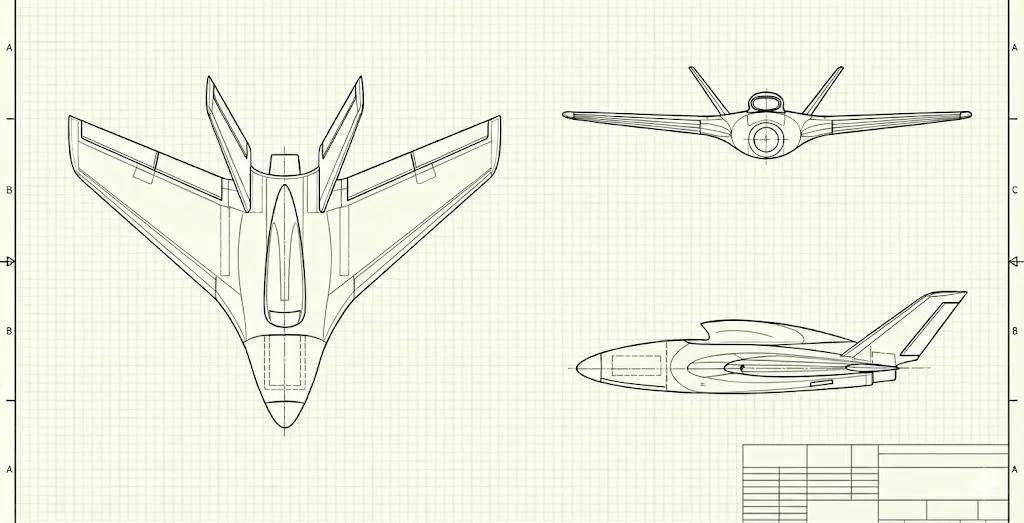
Multiple recent legislation changes massively complicate the building of hobbyist RC planes in the United States. As of December 2025, the FCC added all new foreign-made drone models and "critical components" (flight controllers, radios, etc.) to the Covered List.
This doesn't mean it's illegal to own them, but it means new foreign models cannot be authorized for sale or import into the US. Unfortunately, the RC and drone industry in the U.S. is oriented only towards expensive/high-end weapons systems, leaving a critical hole in the market for hobbyist/educational RC components.
Because of the recent American Security Drone Act (ASDA), schools and universities are strictly prohibited from using drones or components manufactured by "covered foreign entities" (specifically China, DJI, Autel.) 7 of the 10 leading drone component manufacturers are based in China.
So, what are our options?
THE TWO-TRACK STRATEGY
Our research has led us to a "Difficulty in Direction." To solve for both the hobbyist/arcade market and the restricted educational market, we are forced to design the Yeehata MONO as a modular platform that can accept two entirely different component systems depending on the mission profile. We can focus on the VR arcade application now while we wait and hope for the U.S. component market to come online.
A second long-term moonshot for the project is a self-docking farm surveillance drone that will periodically automatically take off, fly the perimeter or total area of the farm and identify predators, frozen water sources, fence damage, cattle health etc. This drone will consolidate all of this info into brief, trustworthy reports to identify cattle herd needs remotely, and land/charge on dock without human intervention.
This requires significant R&D and software development, specifically offline-AI capabilities and precision docking currently out of scope. However, the design philosophies we are baking into the Yeehata MONO today (extreme durability, modular repairability, and legislative compliance) are the exact DNA required for that future.
CONCLUSION // NEXT_STEPS
The current line of thinking has landed on attempting to build a sub-250gram RC EDF as an unassembled kit to avoid the need for RemoteID and be small and safe enough to fly in a gym or hanger around people. While sourcing U.S. parts for this philosophy is currently impossible, we can remain legal by letting the customers purchase components and assemble it themselves, while aligning ourselves for future goals.
CURRENT OBJECTIVES:
- [ ] Finalize the sub-250 gram b.o.m. and order parts.
- [ ] Creating bounding box template for components.
- [ ] Design and model airframe
To Be Continued...
COMMENTS_CHANNEL
No comments yet. Be the first transmission.